Healthcare / Human–AI workflows
Giving coders their
focus back.
I redesigned a medical coding workflow so AI and verifiers prepare the chart, and coders can concentrate on clinical judgment.
Explore the decisions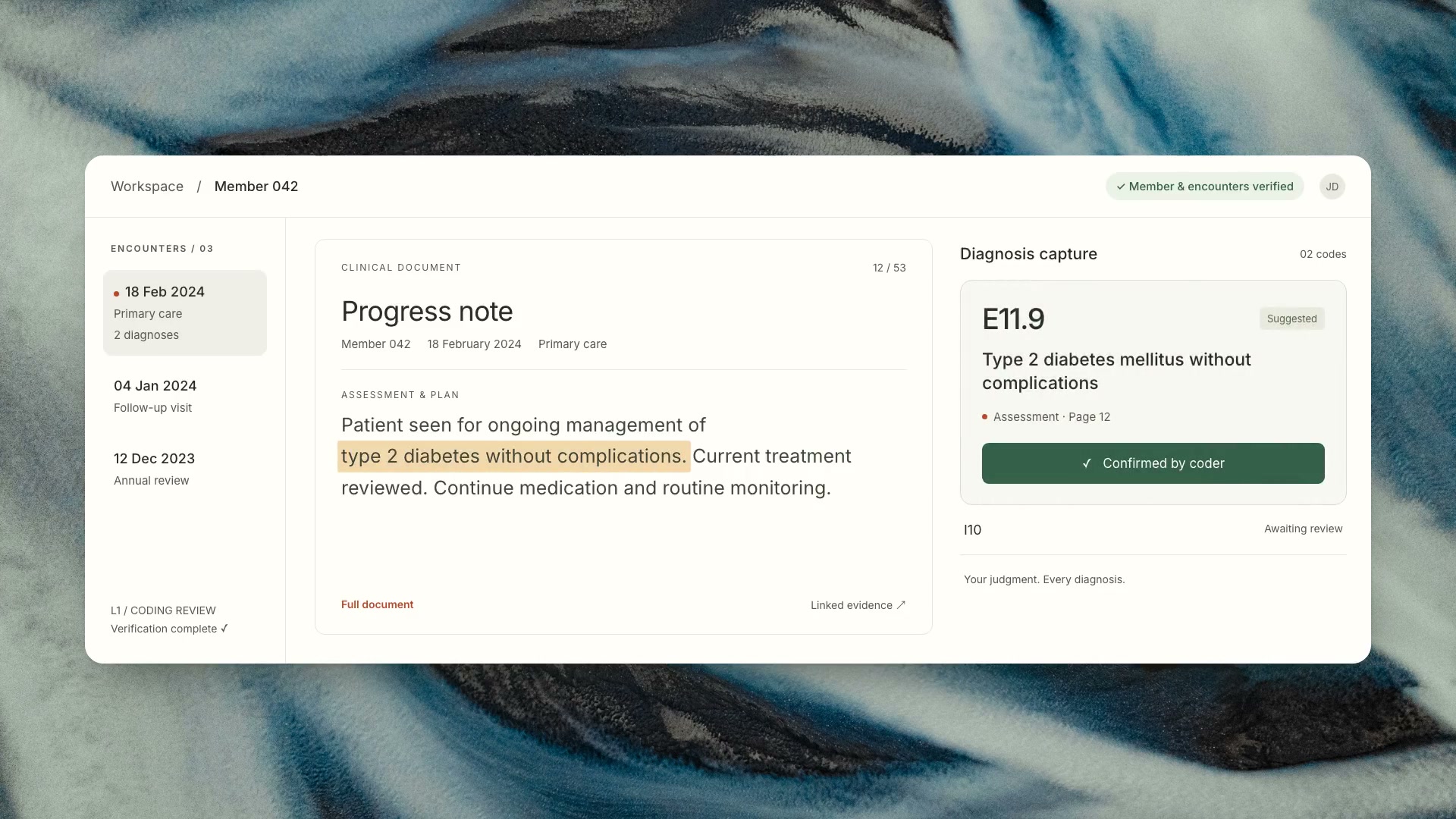
Zero errors detected in the reported QA results.
85% overall rating for member verification.
Shared design ownership in 2024; sole designer from 2025.
L1 coding / The chart arrives prepared
Press “Capture E11.42” to record the coder’s decision. Press again to undo.Diagnosis capture
Pre-verified by L0Credentials: MD · corrected by L0
Type 2 diabetes mellitus with diabetic polyneuropathy
NLP suggestion · page 6Assessment & plan
Type 2 diabetes mellitus with diabetic polyneuropathy. Reports numbness and tingling in both feet M. Monofilament exam shows reduced sensation in both feet; A1c 7.8% E. Neuropathy assessed as stable A. Continue metformin; refer to podiatry T.
M · E · A · T marks the Monitor, Evaluate, Assess, and Treat evidence a coder checks before capturing. Fictional note written for this demonstration.
Two findings, one code
The note links both conditions, so one combination code replaces the pair. Capturing it marks both underlying findings as covered.
- 1Verification arrives complete. The one L0 correction travels with the chart, so the coder can see what changed.
- 2The passage is highlighted in the source, with its MEAT support marked, instead of summarized away.
- 3The combo relationship is shown, so the coder does not reconstruct it from memory.
Fictional chart and codes; simplified interface.
01 / The process
A speed problem with a deeper cause.
More than 3,000 medical coders review patient documentation and capture diagnosis codes used in risk adjustment. They work under pressure to move quickly, while incorrect coding carries financial and compliance consequences.
The business case showed that 66% of their time went to scrolling and validating. The existing workflow asked the same person to verify the patient, check the encounter, read the chart, and code it. Optimizing individual clicks would leave those competing responsibilities in place.
Before: four jobs competing for one coder’s attention
The same person checks identity, verifies encounters, finds evidence, and captures diagnoses. This reconstruction makes the original responsibility problem visible.
| Chart | Member details | Encounter | Diagnosis |
|---|---|---|---|
| Example chart A | Find name and DOB on each page | Check dates, provider, credentials | Search 12 pages for evidence |
| Example chart B | Name mismatch on page 8? | Merge two encounters? | Not started |
| Example chart C | Not started | Not started | Not started |
One coder carries every responsibility. Mechanical verification repeatedly interrupts clinical judgment.
What I owned
Workflow and interaction design, verification states, the coding workspace, feature design, training guides, and user surveys. I shared design ownership with a Principal Designer in 2024, then became the sole designer in 2025.
How I worked
In a product trio with PM and engineering, with equal influence on product direction. I connected the workflow architecture to the details coders would encounter every day.
The team boundary
Engineering and data science owned NLP and the backend. Compliance requirements were established with the business. My responsibility was the experience of using, checking, and correcting the AI output.
02 / The process
Move the work to the right person.
I advocated for separating verification from coding. L0 combines NLP extraction with a dedicated verification workflow. L1 receives the prepared chart, with clear signals about what has been checked.
This changed the product beyond its screen layout. It introduced a handoff, a dedicated verification role, and a responsibility to make unresolved work visible. I shaped those boundaries with product and engineering.
After: one chart, four owners
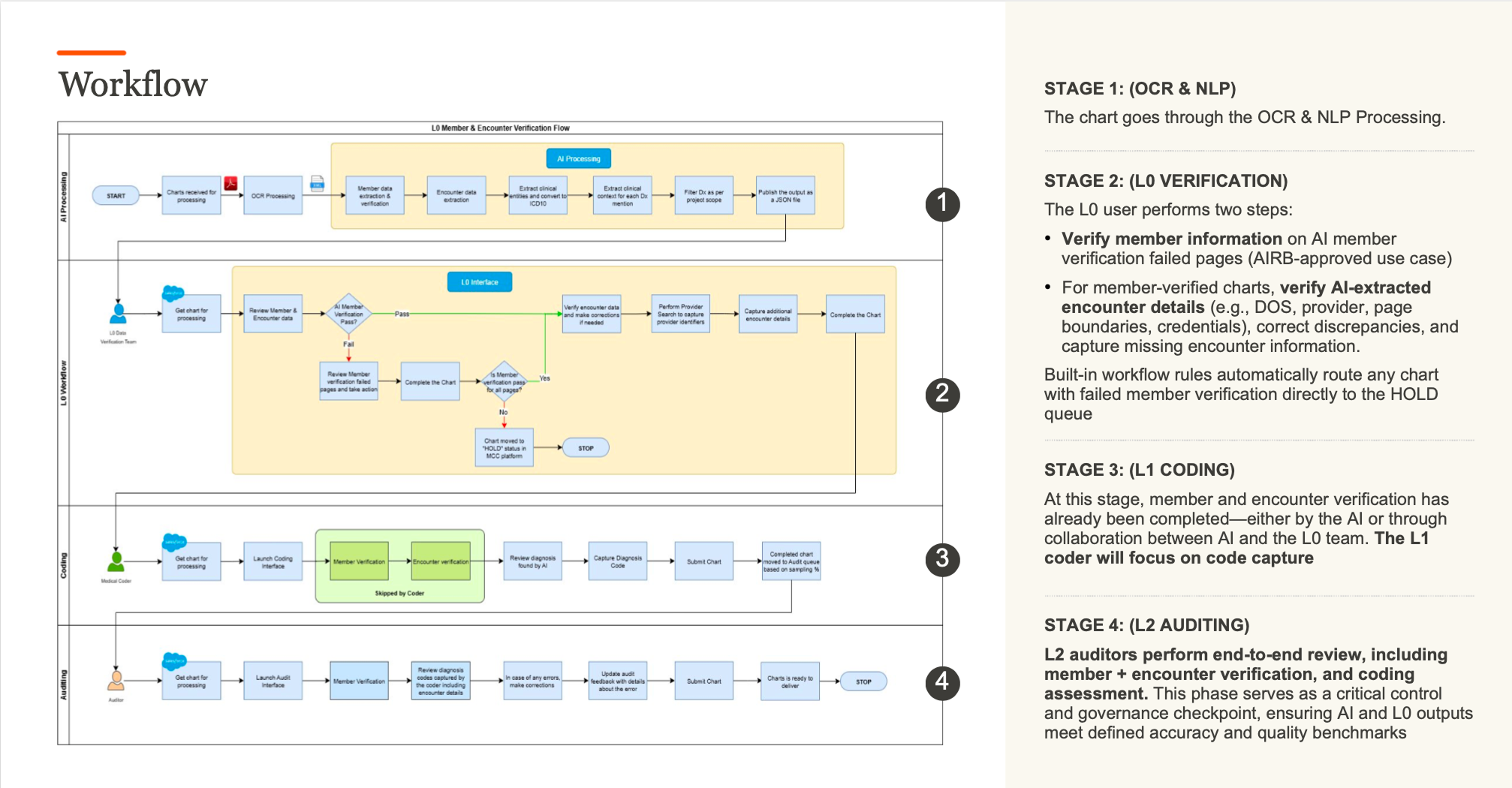
Transcribed from the original workflow slide below. Each lane receives only work the previous lane has resolved.
- AI processing
- OCR and NLP extract member, encounter, and diagnosis data
- AI member check passes or flags pages
- L0 · Verification team
- Review only the pages the AI check flagged
- Identity fails → HOLD queueWith a reason such as “Patient DOB missing.” The chart stops before any coder sees it.
- Verify encounters: dates, pages, provider, credentials, signature
- L1 · Coder
- Member verification: skipped by coder
- Review AI-found diagnoses beside the source
- Capture codes and submit
- Audit
- A sample of completed charts receives an end-to-end review
Original workflow slide
The source for the diagram above. The green area marks the checks a coder skips after preparation.
L0 verification / Correct the extraction before handoff
NLP missed the provider’s credentials. The verifier checks the source, applies the value, and only then can the chart move to L1. Press the button to apply the correction; press again to undo.
Encounter 01
Source · page 7Electronically signed by Example Provider, MD
Other corrections: Confirm · Modify · Merge · Split · Add
Waiting on 1 field
The chart hands off to L1 only when every field matches the source. The correction stays visible to the coder.
The chart goes to the HOLD queue with a reason and never reaches a coder.
The alternative
Add NLP assistance inline while keeping every responsibility with the coder. It would require less organizational change.
The trade-off I accepted
The split makes the overall system more complex. Dedicated roles, routing, and handoff logic must work so the individual coder can focus.
The design decision was who should do the work, before it was how the screen should look.
03 / The process
Make the AI useful.
Keep judgment visible.
NLP can merge encounters incorrectly, miss information, or extract the wrong provider details. A polished interface should not make an uncertain extraction look like established truth.
I designed a correction toolkit for L0 and clear verification states for L1. Users can understand what was checked, what is incomplete, and when they need to intervene.
Verification required
Preparation is unresolved. The interface makes the need for review explicit.
Do not assume extracted means verified.Partially verified
Some checks are complete; remaining flags name the exact pages.
87.4% positive in the 887-person pilot: the alert helps identify flags quickly.Verification complete
The completed checks are visible to the coder receiving the chart.
Move forward with context.An intentional interruption
A mandatory AI acknowledgment explains that extracted information does not replace professional judgment. I accepted the extra interaction as part of making responsibility explicit.
Correction is part of the product
Confirm, modify, merge, split, and add actions make imperfect extraction recoverable. A disclaimer alone cannot provide that control.
Three panels, one decision in progress
Coders need the source document while capturing diagnoses. I placed diagnosis capture, the chart, and reference material together to support that cross-checking. Combo-code relationships became visible, while section headers helped people locate relevant passages.
04 / The process
Strong signals.
A clear next iteration.
I designed and analyzed surveys to understand whether the workflows helped users. Two studies answered different questions: a larger member-verification pilot and a smaller coding alpha.
The results supported pre-verification and several coding features. They also showed that the three-panel container needed further work.
Member verification pilot
887 participants · Phase 1 controlled pilot · 13 April 2026
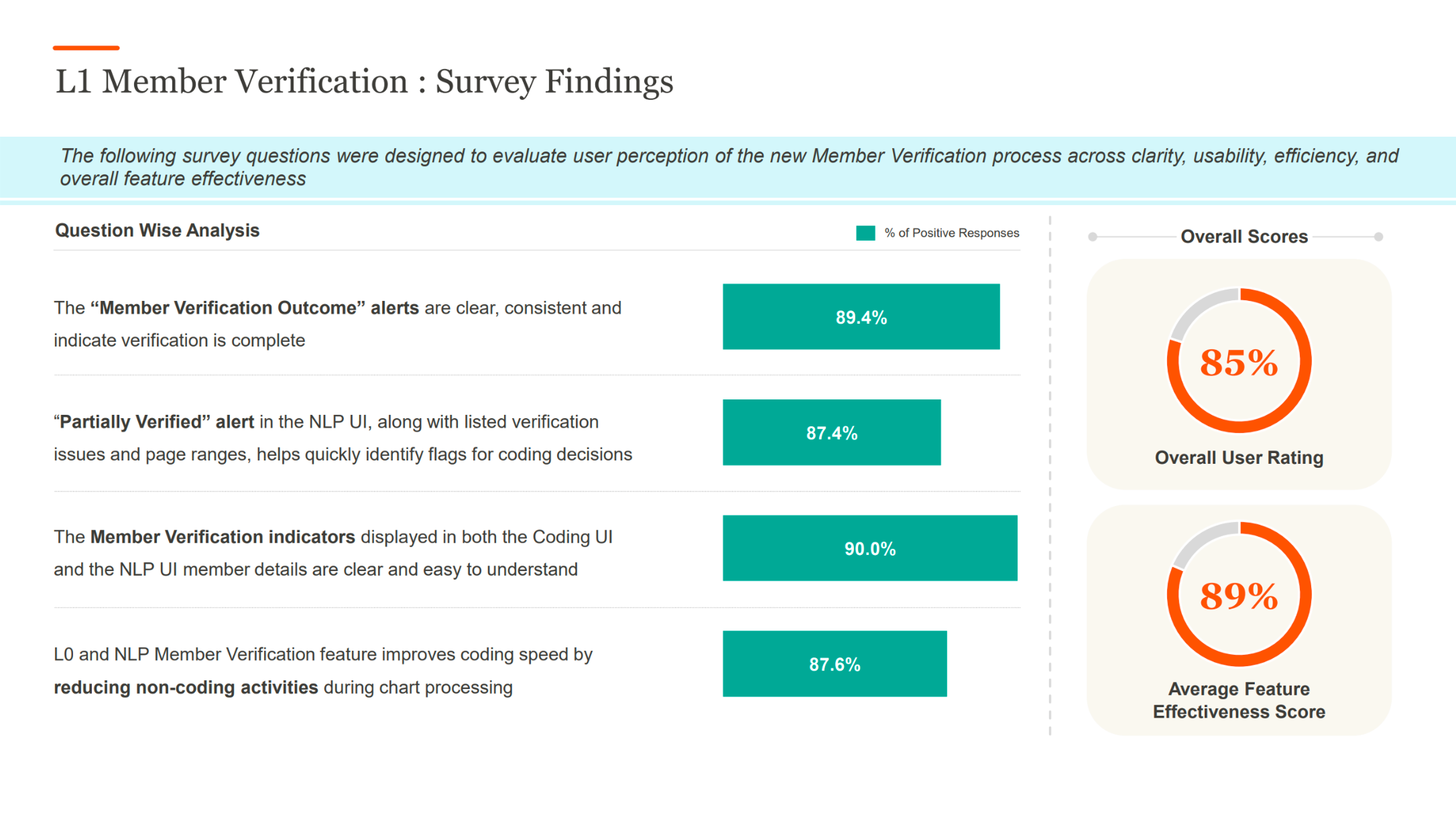
85% overall rating
89% average feature effectiveness. 90% found verification indicators clear and easy to understand.
87.6% said verification improves coding speed by reducing non-coding activities. 89.4% found verification outcome alerts clear and consistent.
Reported QA results: 30,000+ charts audited with zero errors detected. This describes the observed audit, not a guarantee of zero future errors.
Adaptive coding alpha
20 participants · 27 March–17 April 2026
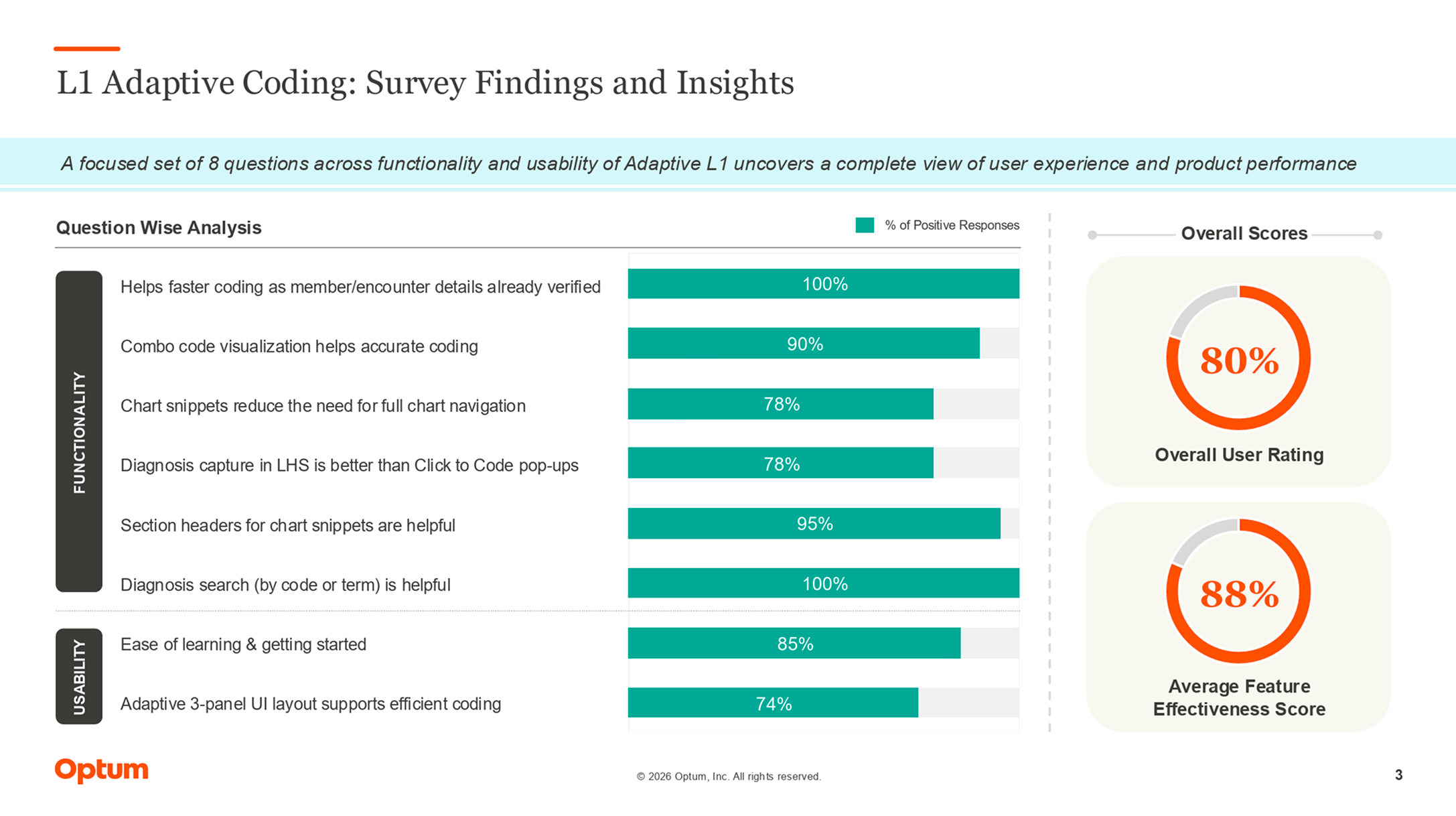
80% overall rating
88% average feature effectiveness. Pre-verified details and diagnosis search both received 100% favorable responses.
Small-sample feedback is directional. It does not establish an organization-wide productivity effect.
The layout scored below the features inside it.
I designed for simultaneous access to dense information. The lowest score, 74% for the three-panel layout, suggests that this can become too much to process at once. Useful information still needs a manageable container.
Feature-level results from the coding alpha. Scores are reproduced from the source survey, not recomputed from a combined participant pool.
Question 1 / Does pre-verification help coders at scale?
Original slide, member verification pilot, 887 participants. Its key results are transcribed in the study card above: 85% overall, 89% average feature effectiveness, 90% indicator clarity.
Question 2 / Which coding features help, and does the layout?
Original slide, coding alpha, 20 participants. The feature ratings above are transcribed from it; the three-panel layout scored lowest at 74%.
05 / The process
Own the next question, too.
My next iteration would test progressive panel disclosure: keep the current task prominent and reveal supporting panels as needed. That proposal still needs validation.
The alpha also pointed to tighter MEAT-reference integration and performance on charts with many encounters. Those remain product problems to solve, alongside the visual density.
Next-iteration concept / One task in front
Unshipped and untested. A sketch of progressive panel disclosure, prompted by the 74% layout rating. The source stays open because a coding decision depends on it.
Everything is visible at once. Rated 74% for efficient coding.
Capture and source lead. References open beside the passage when the task needs them.
Good AI interaction starts with a clear division of responsibility.
Adaptive Coder taught me to work at both levels: shape the workflow with product and engineering, then make its responsibilities legible in the interface. The AI prepares evidence, verifiers check it, and coders retain clinical judgment.
What this work demonstrates: product direction, complex workflow design, human–AI interaction, and ownership through validation.